

Overview
A production application environment was undergoing rising infrastructure complexity and unnecessary cloud consumption. The organization engaged D3V to assess its Google Cloud environment and identify opportunities to reduce waste, strengthen security, and establish a more predictable infrastructure model.
D3V conducted a utilization-driven optimization across compute, database, networking, storage, monitoring, IAM, and cloud billing. By aligning infrastructure capacity with actual production workloads, the environment was transformed into a more secure, efficient, and cost-conscious foundation for continued growth.
The Challenge
The production environment had resources configured beyond its observed workload requirements, creating both cost and operational inefficiencies.
The organization needed to:
- Reduce unnecessary cloud infrastructure expenditure.
- Align compute and database resources with actual utilization.
- Secure database connectivity without disrupting the application.
- Establish predictable Cloud Run scaling behavior.
- Remove unused cloud resources.
- Improve infrastructure and billing visibility.
- Strengthen IAM using least-privilege principles.
The challenge was to optimize the environment without compromising application performance, availability, or operational continuity.
Our Solution
Right-Sizing Cloud SQL
D3V analyzed production database utilization and identified significant excess capacity.
The Cloud SQL environment was optimized by:
- Reducing compute capacity from 4 vCPU / 16 GB to 2 vCPU / 12 GB.
- Reducing allocated SSD storage from 100 GB to 70 GB.
- Migrating database connectivity from Public IP to Private IP.
- Validating application connectivity and database performance after the changes.
This aligned database infrastructure more closely with actual demand while improving the security of database communication.
Optimizing Cloud Run
D3V optimized the production Cloud Run environment to improve resource efficiency and control scaling behavior.
The solution included:
- Implementing Direct VPC Egress for private database connectivity.
- Right-sizing a production service to 1 vCPU and 1 GB memory based on observed utilization.
- Standardizing maximum instance settings across services and revisions.
- Configuring controlled autoscaling with a maximum of 5 instances.
The result was a more predictable and controlled compute environment, reducing the risk of unnecessary resource consumption during periods of increased demand.
Eliminating Unnecessary Resources
D3V reviewed the broader Google Cloud environment to identify unused and unnecessary resources.
This included:
- Removing an unused Cloud Build storage bucket.
- Reviewing application image storage requirements.
- Implementing controlled public read-only access where required.
- Simplifying the overall storage environment.
These changes reduced infrastructure clutter and eliminated avoidable resource consumption.
Strengthening Monitoring and Security
Infrastructure optimization was complemented by improved observability and security controls.
D3V implemented:
- Cloud Monitoring alerts for Cloud SQL CPU and memory utilization.
- Cloud Run CPU and memory alerts.
- Project-level Cloud Billing budget alerts.
- IAM permission reviews.
- Removal of unnecessary user and service-account access.
- Least-privilege access controls.
The organization gained greater visibility into infrastructure health, resource usage, and cloud spending while strengthening its security posture.
Optimizing Long-Term Cloud Costs
After the infrastructure was right-sized, D3V evaluated the optimized Cloud SQL baseline for long-term cost savings.
A Cloud SQL Spend-based Committed Use Discount was then purchased against the optimized workload rather than the previous over-provisioned configuration.
This approach helped capture long-term savings while avoiding a commitment based on infrastructure capacity that was no longer required.
Business Impact
The optimization initiative created a leaner and more controlled Google Cloud production environment.
The organization benefited from:
- More efficient use of Cloud SQL and Cloud Run resources.
- Reduced unnecessary infrastructure capacity.
- More secure database connectivity through private networking.
- Greater control over application scaling.
- Elimination of unused cloud resources.
- Improved infrastructure and billing visibility.
- Stronger IAM and access controls.
- Long-term Cloud SQL cost optimization through committed usage.
- A more predictable and sustainable cloud operating model.
Key Accomplishments
Infrastructure Right-Sizing
Production resources were aligned with real workload utilization, reducing unnecessary capacity while maintaining application performance.
Secure Private Connectivity
Database connectivity was migrated from Public IP to Private IP, strengthening the production network architecture.
Controlled Application Scaling
Cloud Run autoscaling and maximum instance limits were standardized to create greater predictability and cost control.
Reduced Infrastructure Waste
Unused storage resources were identified and removed, simplifying the cloud environment.
Improved Operational Visibility
Infrastructure and billing alerts provided proactive visibility into resource utilization, performance, and spending.
Stronger IAM Security
Permissions were reviewed and unnecessary access was removed in accordance with least-privilege principles.
Optimized Cloud Commitment
The Cloud SQL committed-use purchase was based on the optimized workload, rather than the previous over-provisioned environment.
Architecture
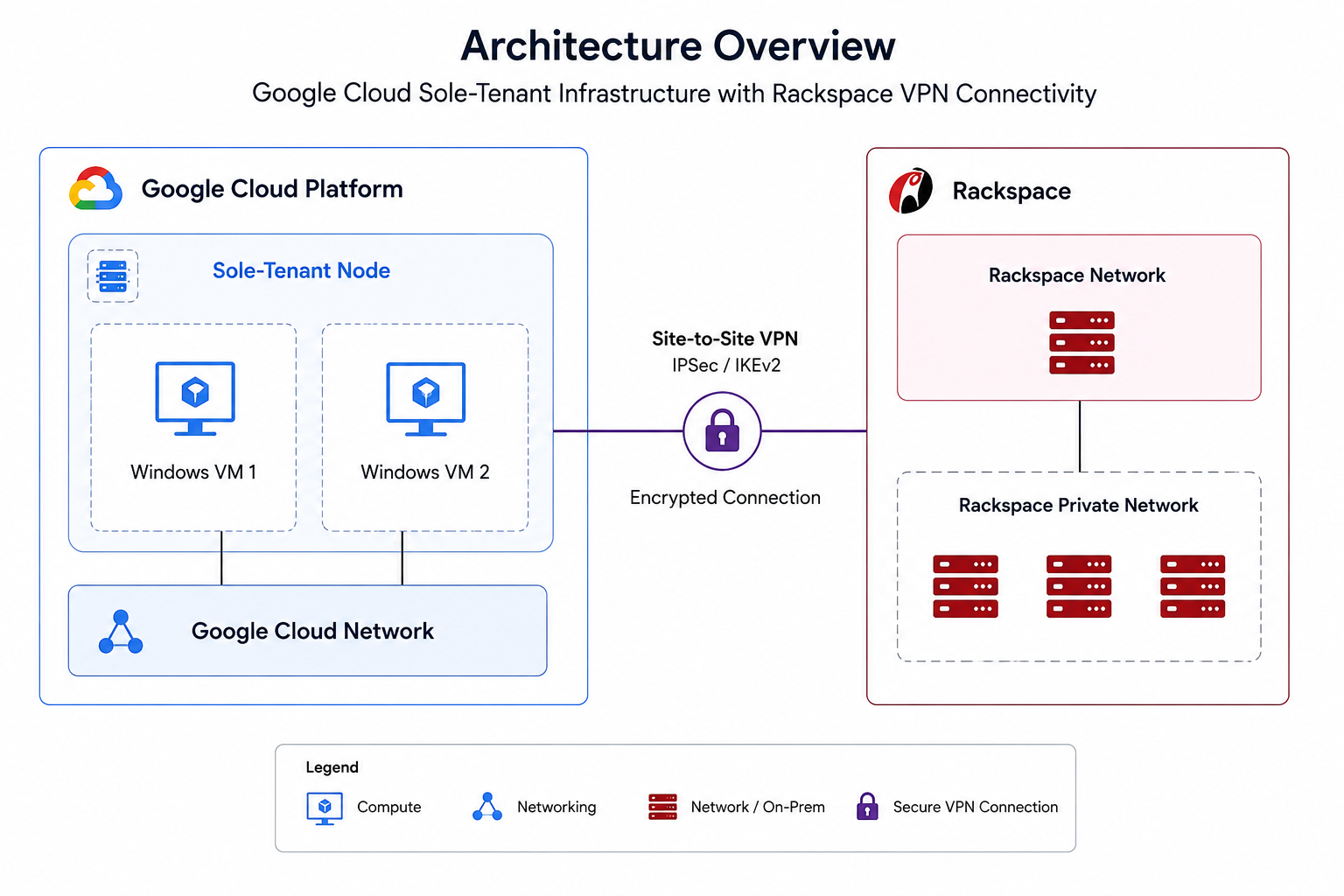
The optimized architecture combined private database connectivity, right-sized Cloud SQL and Cloud Run resources, controlled autoscaling, centralized monitoring, IAM controls, and billing alerts.
Conclusion
D3V helped transform an over-provisioned Google Cloud environment into a more secure, efficient, and predictable production platform.
By combining infrastructure optimization with security, observability, and cost-management practices, the organization established a stronger cloud foundation that can support future growth while keeping infrastructure consumption under control.