
Cloud Migration | Google Maps
High-Scale Cloud Consolidation & CAD Engine Migration for an Enterprise CAD SaaS Platform
Overview
An innovative Computer-Aided Design (CAD) web application was preparing to evolve from a manually operated engineering solution into a scalable, multi-tenant Software-as-a-Service (SaaS) platform. However, its infrastructure was fragmented across multiple cloud providers. The application and compute services were hosted on Google Cloud Platform (GCP), while its PostgreSQL database resided on a third-party managed service outside Google Cloud.
This multi-cloud architecture introduced network latency, operational complexity, deployment inconsistencies, and increased security risks. As customer demand and computational workloads continued to grow, the existing environment lacked the reliability and scalability required for enterprise adoption.
D3V Technology Solutions designed and executed a complete cloud modernization strategy that consolidated the entire platform onto Google Cloud. By eliminating external cloud dependencies, modernizing serverless workloads, implementing a private networking architecture, and automating deployments, the platform was transformed into a secure, enterprise-ready SaaS foundation.
The migration delivered measurable improvements, including the elimination of cross-cloud latency, reliable execution of long-running CAD processing workloads, stronger security controls, and a fully automated continuous delivery pipeline.
Challenge
Before the modernization effort, the platform faced several critical infrastructure challenges.
Cross-Cloud Network Latency
Application services and computational engines operated on Google Cloud, while the transactional PostgreSQL database was hosted externally. Every application request, geometric calculation, and database transaction traversed public internet routes between cloud providers, increasing latency and introducing unnecessary operational risk.
Long-Running Compute Failures
The application’s Python-based CAD processing engine handled computationally intensive parsing and geometry calculations. Large design files frequently exceeded standard serverless runtime characteristics, resulting in interrupted processing and inconsistent user experiences.
Lack of Enterprise Operational Controls
The environment lacked production-grade backup strategies, Point-in-Time Recovery (PITR), centralized secrets management, and automated deployment workflows. Database schema updates and application releases were managed manually, increasing the likelihood of configuration drift between environments.
Solution
D3V engineered a comprehensive Google Cloud architecture focused on security, resiliency, scalability, and operational automation.
Database Consolidation & High Availability
The external PostgreSQL database was migrated to Google Cloud SQL for PostgreSQL, consolidating the application’s infrastructure onto a single cloud platform.
The migration preserved application compatibility, database integrity, and transactional consistency while minimizing operational disruption.
To improve resiliency, the production database was deployed with High Availability (HA), including:
- Automatic standby replica in a separate availability zone
- Automated daily backups
- Seven-day retention policy
- Point-in-Time Recovery (PITR)
This significantly improved availability while reducing recovery objectives in the event of unexpected failures.
Compute Optimization for CAD Processing
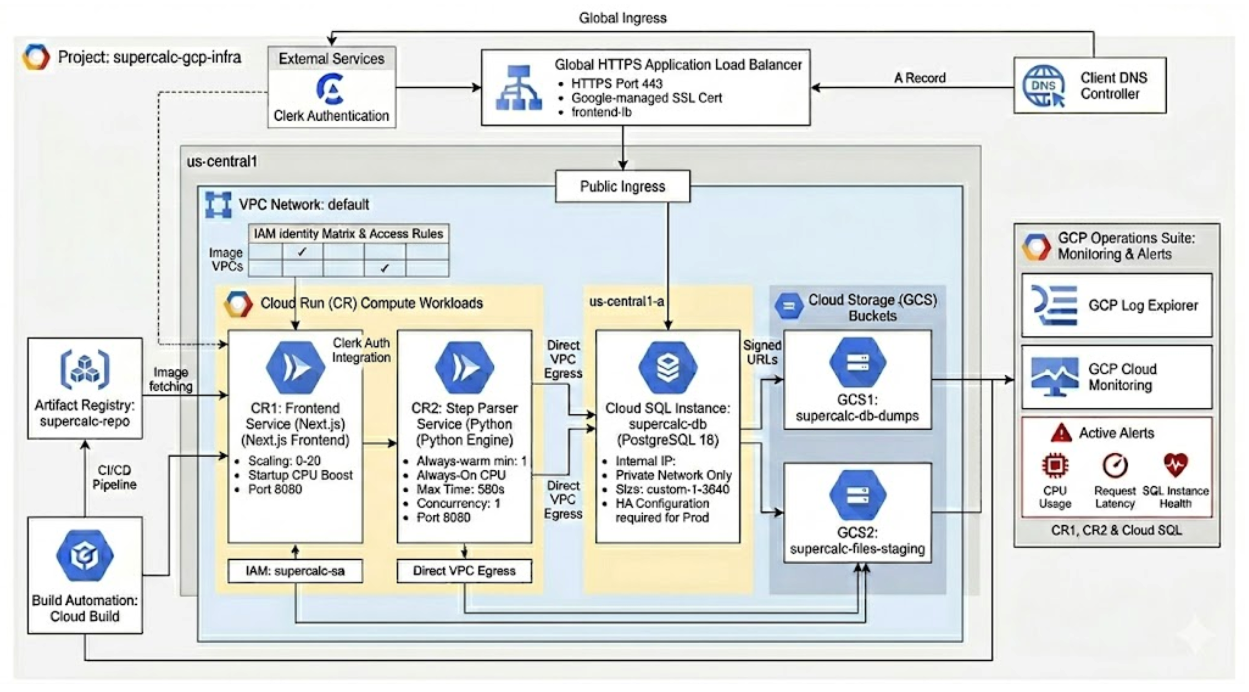
Application workloads were separated into independently scalable Cloud Run services, each optimized according to its workload characteristics.
Frontend Application
The web application was deployed using request-based CPU allocation with Startup CPU Boost enabled to reduce cold-start latency while maintaining cost efficiency through automatic scaling.
CAD Processing Engine
The Python-based processing engine was configured as a continuously warm Cloud Run service with:
- Minimum Instance = 1
- Always-Allocated CPU
- Single-request concurrency
- Extended execution time for computational workloads
This architecture provided consistent performance for long-running CAD parsing operations while eliminating timeout-related failures experienced in the previous environment.
Zero-Trust Private Networking
Security was strengthened through a fully private networking architecture.
Key improvements included:
- Removal of public IP access from Cloud SQL
- Direct VPC Egress between Cloud Run and Cloud SQL
- Private communication over Google’s internal network
- Identity-Aware Proxy (IAP) for administrative access
- Cloud SQL Auth Proxy for secure database connectivity
- Google Secret Manager for centralized credential management
- Global HTTPS Load Balancer protected by Google-managed SSL certificates
The resulting architecture dramatically reduced the external attack surface while simplifying secure operational access.
Additionally, D3V provided architectural guidance for implementing a future disaster recovery strategy to support regional failover and long-term business continuity.
CI/CD & Automated Database Migrations
Manual deployment processes were replaced with an automated Google Cloud Build pipeline integrated directly with GitHub.
Separate deployment pipelines were established for different environments, improving release quality and reducing deployment risks.
Database schema management was integrated into the deployment workflow using Drizzle ORM, enabling automated schema validation and migrations during every deployment.
This eliminated manual database synchronization while ensuring consistency across development, staging, and production environments.
Business Impact
The modernization initiative transformed the platform into an enterprise-ready SaaS solution capable of supporting future growth.
Elimination of Cross-Cloud Latency
By consolidating application services and databases onto Google Cloud, all database communication now occurs entirely over Google’s private network, significantly improving response times and reducing application latency.
Reliable CAD Processing
Dedicated serverless compute optimization eliminated parser interruptions and timeout-related failures, allowing complex CAD workloads to execute consistently and reliably.
Enterprise Security & Resilience
The new architecture introduced:
- High Availability database deployment
- Private networking
- Automated backups
- Point-in-Time Recovery
- Centralized secrets management
- Secure identity-based administrative access
These improvements significantly strengthened the platform’s security posture while increasing operational resilience.
Automated Delivery
Infrastructure automation and integrated database migrations accelerated software delivery while reducing manual intervention and deployment errors.
Predictable & Cost-Efficient Operations
Optimized Cloud Run services and right-sized infrastructure enabled a lean operational footprint while providing the flexibility to scale seamlessly as customer adoption increases.