
Google Cloud
Seamless Migration from On-Prem VMware to Google Cloud VMware Engine (GCVE)
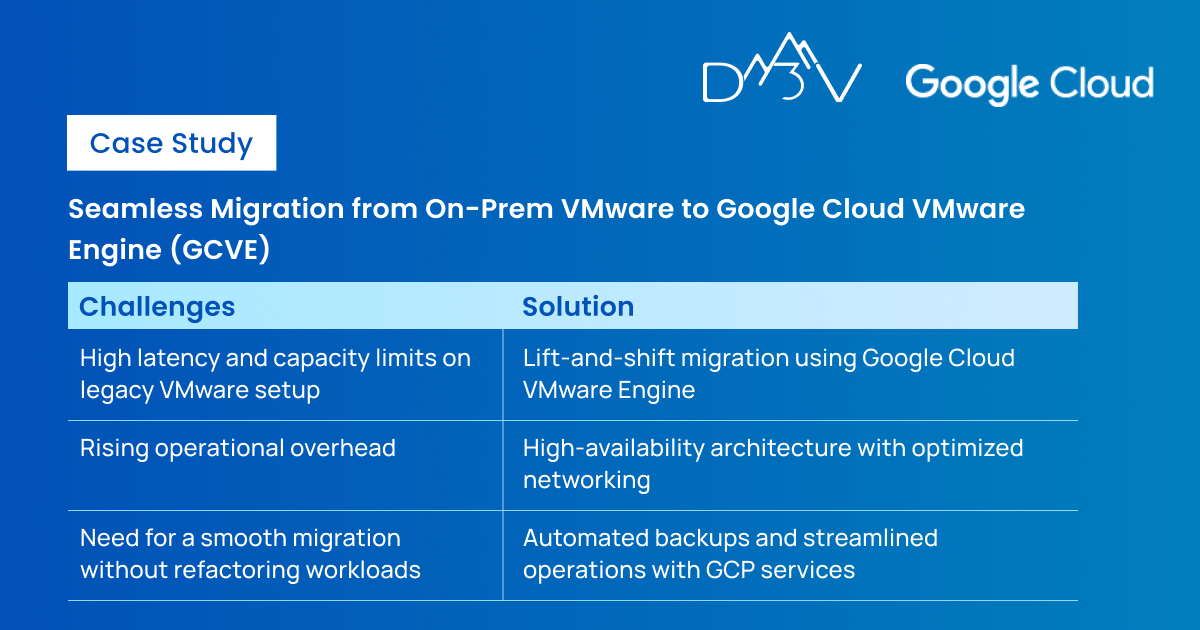
Overview
Migrating enterprise workloads from an on-premises VMware environment to Google Cloud VMware Engine (GCVE) requires deep expertise across networking, cloud architecture, security, and VMware administration. This article highlights how our team successfully executed a full-scale migration for an enterprise organization in the logistics sector, overcoming major infrastructure challenges and delivering a secure, high-availability cloud environment.
Challenge
Core Challenge: Migrating enterprise workloads from an on-premises VMware environment to Google Cloud VMware Engine (GCVE), which required deep expertise across various technical domains.
Key Challenge: The initial implementation of a policy-based VPN for hybrid connectivity had routing limitations, requiring a shift to a more scalable route-based VPN.
Solution
1. Establishing a Reliable Hybrid Connectivity Backbone
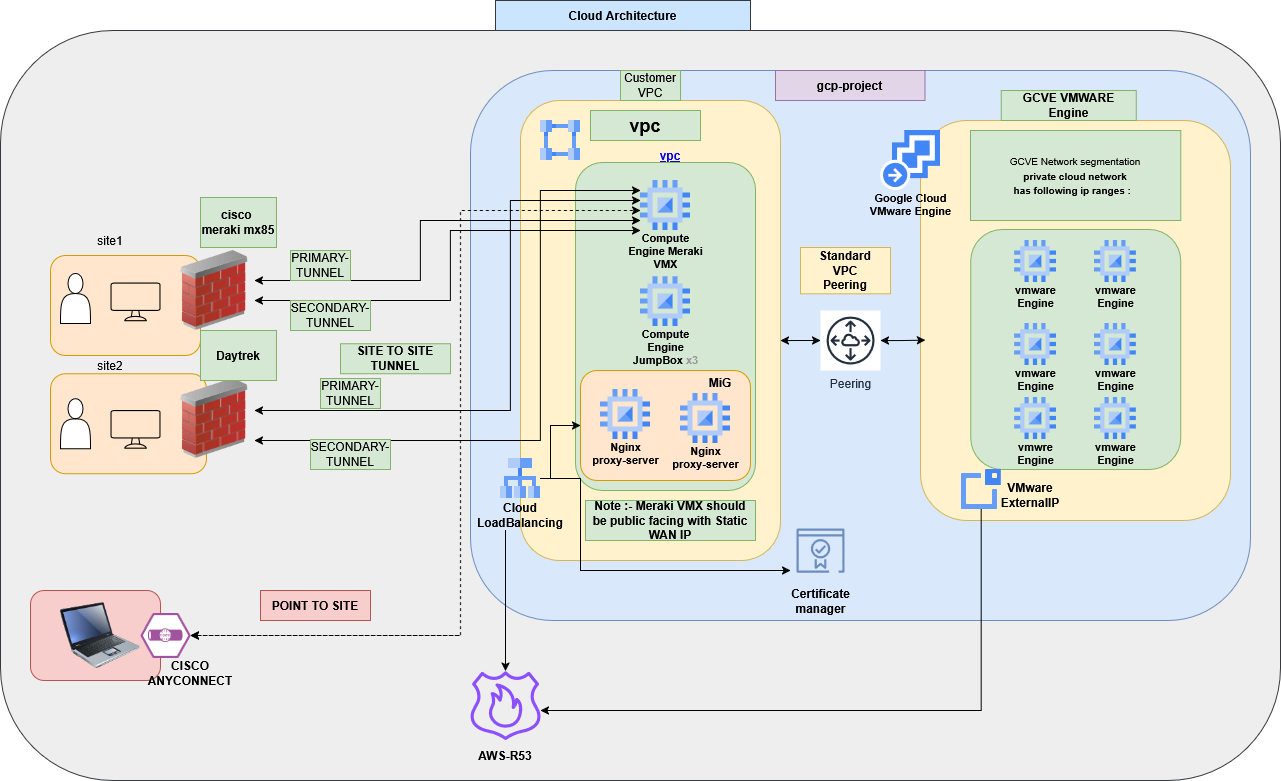
The first and most critical phase was building a stable and secure network connection between the client’s on-premises datacenter and Google Cloud. Initially, a policy-based VPN was implemented, but routing limitations led us to shift to a more scalable route-based VPN. After stabilization, we deployed a Meraki vMX appliance in GCP, enabling:
-
- Site-to-Site VPN for all the organization’s branch offices
- Point-to-Site VPN for remote employees
This provided unified secure connectivity across all locations.
2. Executing the VMware Migration to GCVE
With hybrid connectivity established, we migrated 50+ VMware virtual machines into GCVE using native HCX migration tools. The transition ensured minimal downtime and preserved existing VMware operations. Static IPs were assigned to licensing-dependent servers using GCVE’s native network capabilities.
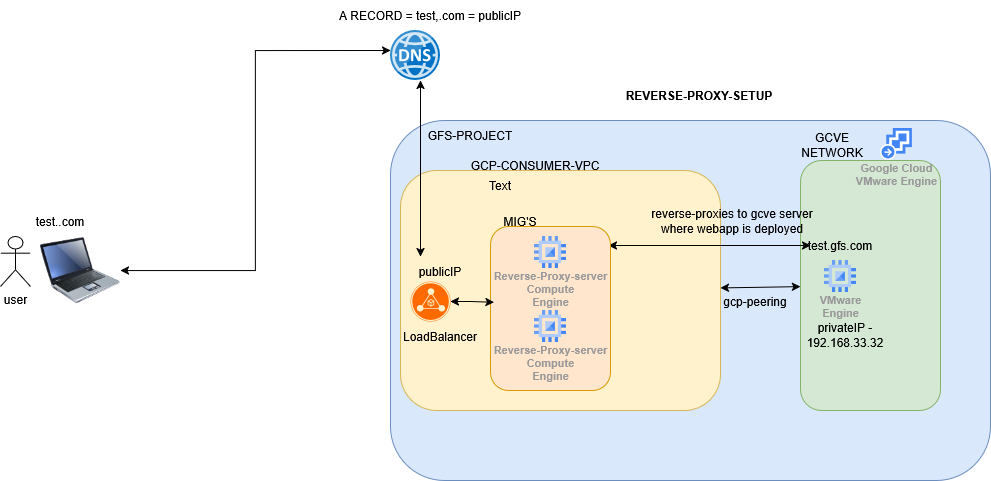
3. High Availability Through NGINX Reverse Proxy and Load Balancing
To ensure reliable and secure application access, we implemented an NGINX-based load-balancing reverse proxy. This provided a single unified public IP for all applications and seamless HTTPS routing. SSL certificates were integrated using Google Cloud Certificate Manager, and Route53 DNS ensured fast global resolution.
4. Strengthening Security With GCVE Network Policies
GCVE’s granular network policy controls were used to enforce least-privilege access, isolate workloads, and harden east–west traffic security.
5. Troubleshooting Docker-Based API Performance Issues
Some API containers experienced slow data-fetch operations after migration. Our team diagnosed and fixed these issues, restoring expected performance levels.
6. Managing GCVE VM Backups with Google Cloud Backup and DR
To ensure business continuity, we integrated Google Cloud Backup and DR to automatically protect all GCVE VMs. Policies were configured for:
- Automated VM snapshot backups
- Application-consistent backup scheduling
- Cross-region backup replication for added resilience
- Quick recovery workflows for GCVE-based workloads
This provided a complete, fully managed backup and restoration strategy for all migrated virtual machines.
7. End-to-End Cloud, DevOps, NetOps, and VMware Expertise
This project covered multiple domains, including cloud engineering, DevOps automation, VMware administration, and advanced NetOps. Our team delivered a highly resilient, secure, and optimized GCVE environment.
Conclusion
The migration of the organization’s infrastructure to Google Cloud VMware Engine demonstrates how organizations can modernize their VMware environments while maintaining operational continuity. With high availability, secure connectivity, automated backups, and optimized services, this cloud foundation supports long-term scalability and reliability.