Overview
In production computer vision, rapid model iteration depends directly on the reliability, throughput, and stability of distributed training pipelines. Machine learning teams pushing the envelope in object detection require high-performance hardware accelerators capable of processing complex visual datasets rapidly and cost-effectively.
As Google Cloud introduced its next-generation Cloud TPU v5e offering substantial cost-efficiency and computational throughput improvements forward-looking enterprises sought to transition away from legacy accelerator generations. However, migrating complex training workloads from legacy Cloud TPU architectures to modern TPU VM runtimes is rarely a simple drop-in replacement. It requires aligning underlying framework dependencies, refactoring distributed runtime engines, and modernizing build pipelines.
When an innovative computer vision and technology company needed to modernize its flagship object-detection training pipeline, they partnered with D3V. Their goal was twofold: modernize and stabilize an aging software and CI/CD foundation, and seamlessly migrate their training workload to Google Cloud TPU v5e. D3V engineered a comprehensive modernization strategy, resolving deep architectural dependencies and delivering a rock-solid, production-grade training pipeline.
The Challenge
The client’s object-detection pipeline had evolved over multiple software iterations, accumulating architectural friction that prevented them from taking advantage of modern Google Cloud accelerators:
- Legacy Accelerator Dependencies: The training framework was tightly coupled to legacy Cloud TPU v2/v3 architectures. These older environments relied on networked gRPC cluster initialization and legacy node discovery that were incompatible with modern, high-performance TPU VM architectures.
- Deep Framework & Runtime Incompatibilities: The pipeline contained mismatched machine learning libraries spanning older TensorFlow releases, legacy Object Detection APIs, and conflicting NumPy versions. Upgrading to modern runtimes required unravelling intricate dependency trees without breaking model accuracy.
- Brittle CI/CD & Build Tooling: Underlying build jobs and deployment tooling relied on outdated runtime environments and deprecated authentication tokens. This created brittle build processes that hindered engineering agility.
- Non-Deterministic Artifact Exports: A structural timing mismatch existed between parallel training and validation jobs. Validation routines frequently attempted to export model artifacts before the training worker had finalized its checkpoints, occasionally causing pipeline runs to register as completed even when model artifacts were missing or incomplete.
To reliably adopt next-generation TPU v5e hardware, the client needed a holistic engineering intervention: stabilizing the foundational build environments, modernizing the distributed training engine, and establishing deterministic pipeline orchestration.
Our Solution
D3V executed a phased modernization roadmap designed to resolve technical debt at the foundation before transitioning the training workloads onto modern TPU v5e accelerators.
1. Build Ecosystem & Runtime Stabilization
Before altering the accelerator engine, D3V modernized the build and container ecosystem to establish a repeatable, production-grade foundation:
- Container Standardization: Standardized the training environment on modern, enterprise-grade base images, pinning to TensorFlow 2.15 with dedicated TPU VM runtime support and Python 3.10.
- Dependency Harmonization: Completely resolved dependency conflicts across lockfiles, ensuring strict compatibility across NumPy, Keras, and specialized vision libraries.
- Modernized CI/CD & Security Posture: Upgraded deployment runners to current LTS Node.js environments and eliminated deprecated token mechanisms in favor of hardened Google Cloud IAM service account authentication.
2. Next-Gen TPU v5e & PJRT Migration
D3V refactored the core training harness to unlock the full computational advantages of Google Cloud’s TPU v5e architecture:
- TPU VM & PJRT Engine Integration: Transitioned the training workload to Google’s modern PJRT C-API runtime, removing legacy gRPC overhead and enabling direct, in-process execution on the accelerator host.
- Intelligent Cluster Resolution: Redesigned the cluster initialization logic with dynamic fallback routing, supporting automated discovery, explicit worker topologies, and localized cluster resolution.
- Optimized Hardware Topology: Provisioned a balanced 4-chip TPU v5e slice (v5litepod-4 using ct5lp-hightpu-4t) in a 2X2 topology, orchestrating 4 synchronized, distributed TPU replicas for parallelized model training.
- Runtime Graph Optimization: Fine-tuned execution step loops and stream handling to eliminate resource contention and guarantee smooth tensor execution under the PJRT compiler.
3. Deterministic Training & Model Export Orchestration
To ensure dependable model deployments, D3V restructured the pipeline's operational boundaries:
- Chief-Worker Export Ownership: Transferred explicit ownership of model compilation and final SavedModel export directly to the primary training worker immediately upon training completion.
- Decoupled Validation Lifecycle: Re-architected the evaluation job to focus strictly on calculating evaluation metrics and scoring checkpoints, eliminating race conditions and ensuring that successful pipeline completions guaranteed valid, deployable model artifacts.
Technical Architecture
The modernized pipeline leverages a fully automated, cloud-native workflow spanning secure CI/CD builds, managed container registries, and distributed Gemini Enterprise Agent Platform, (formerly Google Cloud Vertex AI) Pipelines TPU VM execution.
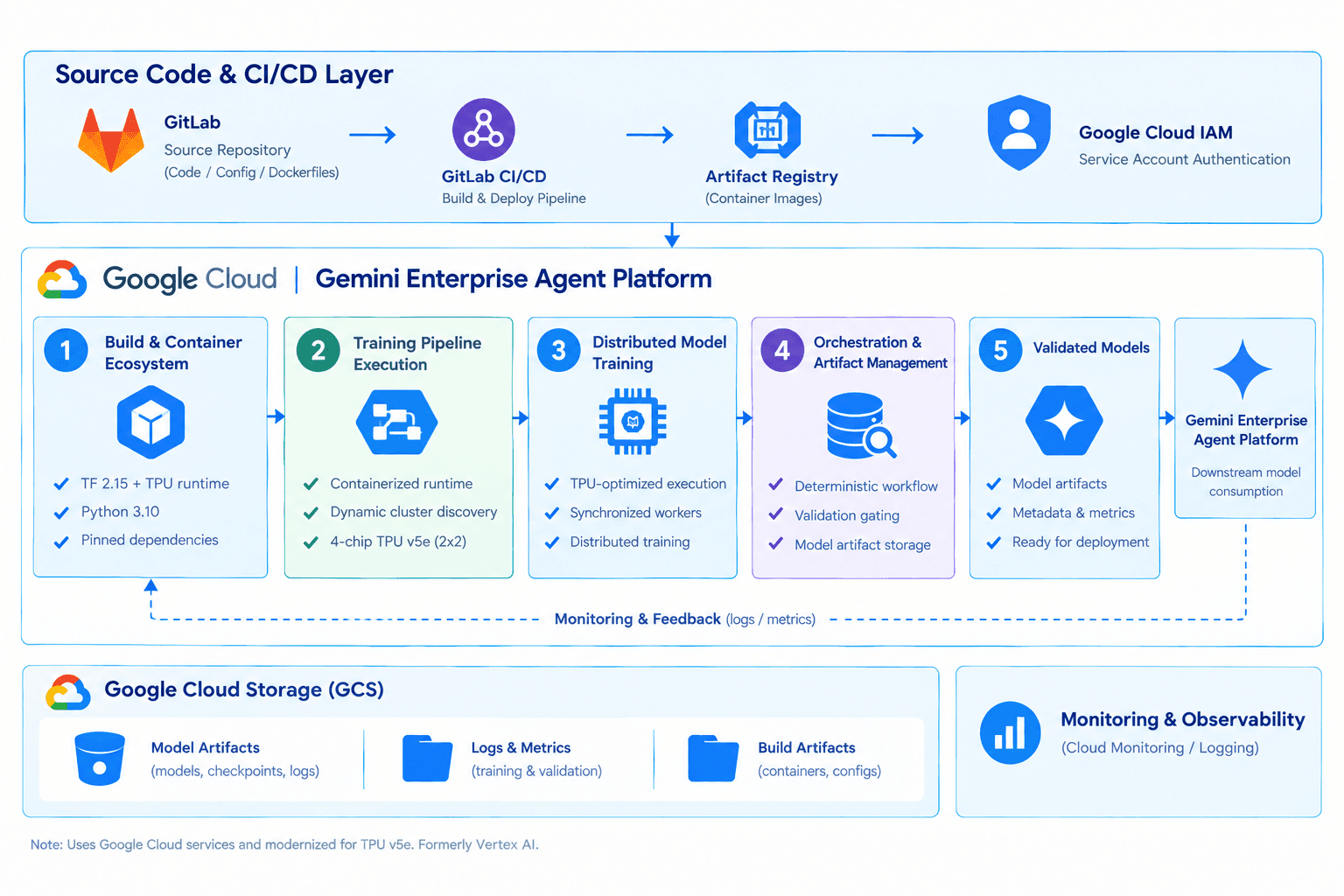
Key Architectural Highlights:
- Gemini Enterprise Agent Platform (formerly Google Cloud Vertex AI) TPU v5e Infrastructure: Employs cost-optimized v5litepod-4 slices running natively on TPU VMs, delivering exceptional price-performance over prior-generation accelerators.
- Unified PJRT Runtime Architecture: Direct device driver bindings via libtpu.so provide low-latency host-to-device data transfers without legacy network hops.
- Deterministic Artifact Management: Training workers directly write structured model artifacts to Google Cloud Storage with automated health validation before downstream promotion.
Business Impact
By modernizing their training pipeline and migrating to Google Cloud TPU v5e, the client established a resilient, next-generation foundation for their computer vision initiatives:
- Accelerated Training Velocity: The optimized TPU v5e cluster delivers substantially faster training throughput compared to legacy Cloud TPU generations and notably outpaces fallback GPU accelerator alternatives, dramatically shortening experimentation cycles and speeding time-to-market.
- Complete Pipeline Reliability: Eliminating legacy dependency conflicts, brittle build tooling, and validation race conditions produced a dependable, repeatable training lifecycle with zero false-positive completions.
- Future-Proofed Accelerator Architecture: Transitioning to the modern TPU VM and PJRT ecosystem ensures long-term compatibility with Google Cloud's active AI hardware roadmap, safeguarding their infrastructure investments.
- Enterprise-Grade Security & Maintainability: Replaced deprecated tokens and fragile legacy scripts with IAM-governed service accounts, modern dependency locks, and structured container management.