
AI/ML
How Real Intent and D3V Built an Agentic Static Sign-Off Debug Platform for The Chip Designers
The Challenge: Debug Knowledge Trapped in Silos
Chip verification teams live and die by speed and accuracy — and Real Intent’s customers were spending it in the wrong places. For example – diagnosing Reset Domain Crossing (RDC) issues with tools like Meridian and iDebug meant hunting through design documentation, bug reports, tool logs, and manuals scattered across formats and systems, all by hand.
Debugging violations meant manually combing through Meridian reports, logs, setup files, and run scripts — requiring significant time and deep domain expertise. Even with early AI assistance in place, multi-step debug remained a step-by-step process rather than a coordinated, intelligent workflow.
Real Intent was thinking bigger from the outset. Their vision: an AI powered debug capability built to grow across every corner of chip verification — CDC, Lint, DFT, and beyond .
There was a second ambition, too. Whatever Real Intent built on Google Cloud needed to travel — deployable inside its own customers’ environments, with the freedom to run on any major LLM provider, including Claude, and the data residency guarantees enterprise customers expect.
The Solution: An MCP-Native Platform, Built to Compound
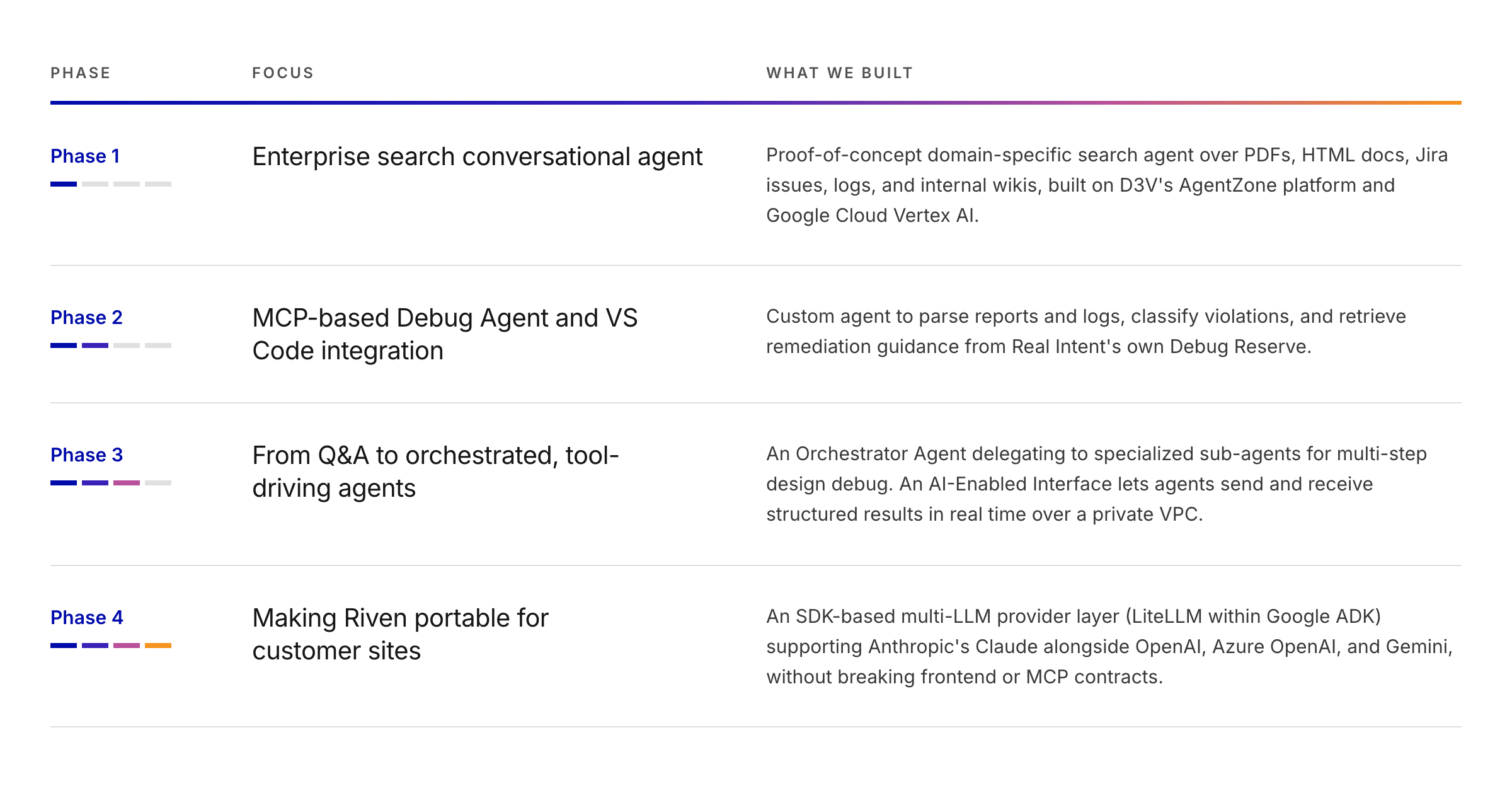
Real Intent engaged with D3V Technology Solutions to help design and deliver the platform in measured, stacked phases — each one turning the last phase’s foundation into the next phase’s launch pad. Every engagement ran remotely inside Real Intent’s own Google Cloud organization.
Starting with Phase 2, the team standardized Anthropic’s Model Context Protocol (MCP) as the way agents talk to tools. Rather than hard-wiring the debug agent to Real Intent’s specific systems, every debugging capability was exposed as a discrete MCP tool.
The Impact: From Scattered Search to Orchestrated Action
✓ Design engineers went from manually searching scattered documentation to a conversational search agent — then to an MCP-based debug agent — then to an orchestrated agentic workflow with live IDebug integration, all built on Anthropic’s open MCP standard.
✓ The entire stack runs on Google Cloud (Vertex AI and Gemini, Cloud Run, Cloud SQL, Cloud Storage, Cloud Build, and IAM), delivered as a coherent clean hand offs and knowledge transfer at every stage.
✓ Phases 1–3 stand as complete, successfully delivered foundations — clearing the runway for the platform’s portable, MCP-consistent, provider-flexible future across Claude and other models.
Growing Demand for Claude Across Real Intent’s Customer Base
Momentum is building beyond Real Intent’s own engineering org. Additional Real Intent customers evaluating the Riven platform for their own verification environments have indicated they intend to run their reasoning-heavy debug workflows on Claude, selected as the model provider through Riven’s Multi-LLM layer. For these customers, Claude’s fit for multi-step, tool-driving reasoning over logs, schematics, and remediation guidance is a key factor in that choice.
Because the provider layer sits behind a stable MCP and frontend contract, each customer can select Claude — or another supported provider — without Real Intent or D3V needing to rebuild any part of the underlying debug workflow. This is expected to make Claude one of the primary providers running in production as Riven rolls out to additional customer sites.
Why Anthropic Is Central to Where This Is Headed
An Open Architecture Built on MCP
Since Phase 2, every debugging capability in the platform has been exposed through Anthropic’s Model Context Protocol, the open standard for connecting AI agents to tools and data. That MCP foundation is what let the project grow into a full orchestrator without rebuilding its integrations.
Claude as a Supported Model Provider
Anthropic’s Claude is one of the providers Riven’s LiteLLM-based provider layer is built to support, alongside OpenAI, Azure OpenAI, and Gemini. For the kind of multi-step, tool-driving debug orchestration Riven performs — reasoning across logs and remediation guidance while coordinating specialized sub-agents — that flexibility means Real Intent’s customers can choose Claude for the reasoning-heavy steps in the workflow, running on the same MCP tool layer already in production, without changing anything else in the stack.