

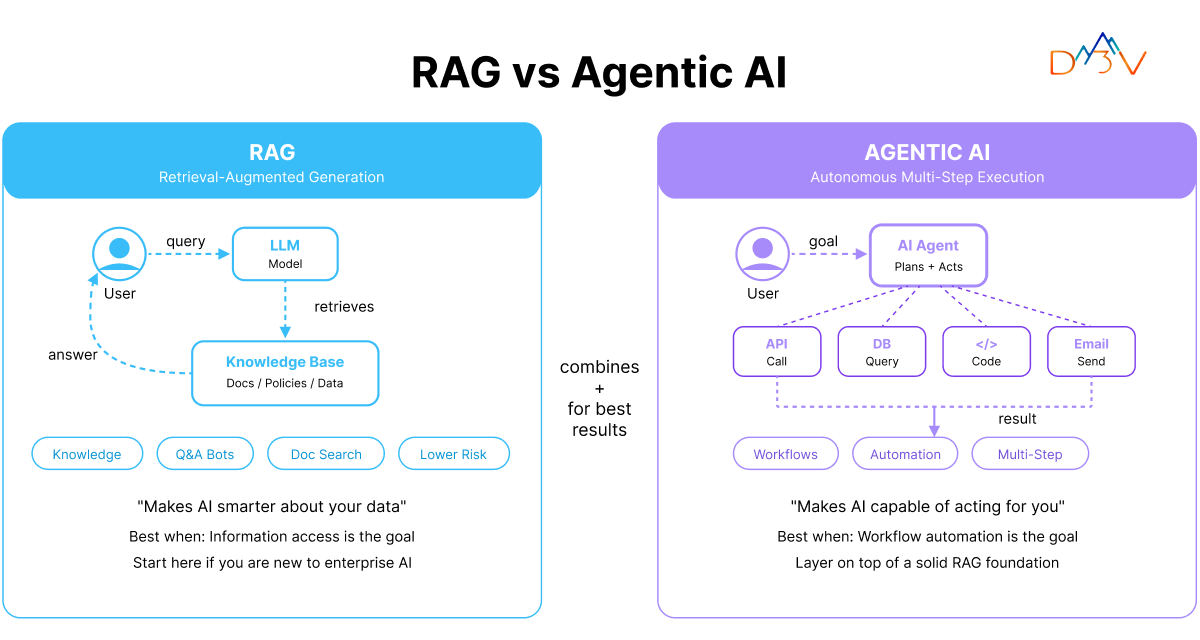
If you have been following the AI space over the last couple of years, you have probably heard both of these terms thrown around a lot. RAG (Retrieval-Augmented Generation) became the go-to approach for enterprises wanting to make large language models work on their own data. Then Agentic AI started gaining traction, promising something more ambitious: AI that can actually take actions, not just answer questions.
So which one should your enterprise be investing in right now? The honest answer is that it depends on what problem you are trying to solve. But let us break down both approaches so you can make a more informed decision.
What RAG Actually Does
RAG is fairly straightforward once you get past the name. Instead of relying solely on what an LLM learned during training, you give it access to a knowledge base at query time. The model retrieves relevant documents or data chunks, then uses that context to generate a response.
Think of it like giving a smart employee a filing cabinet full of your company’s documents before they answer a customer’s question. They are not going off memory alone. They are pulling the right information and using it in their response.
For enterprises, this solves a very real problem. Your LLM does not know about your internal policies, your product catalog, your latest contracts, or your support ticket history. RAG plugs that gap without requiring you to retrain the model from scratch.
Common enterprise use cases for RAG include internal knowledge bases and Q&A tools, customer support bots that pull from documentation, compliance and legal document search, and HR policy assistants. If your primary goal is “make our AI aware of our data,” RAG is usually the right starting point.
What Agentic AI Actually Does
Agentic AI is a different beast. Here, you are not just giving the model information. You are giving it tools and letting it decide how to use them to complete a goal.
An AI agent can browse the web, write and run code, query databases, call APIs, trigger workflows, and chain multiple steps together to accomplish something. You give it an objective, and it figures out the path to get there.
A simple example: instead of asking “what are the top three overdue invoices?” and getting a text answer, an agentic system could query your billing system, identify the overdue invoices, draft follow-up emails, and schedule them to send. All from a single prompt.
This is where things get genuinely exciting for enterprise automation. Agentic AI can compress multi-step human workflows into automated pipelines that run with minimal oversight.
The Core Difference
Here is a simple way to think about it. RAG makes AI smarter about your data. Agentic AI makes AI capable of acting on your behalf.
RAG is about knowledge. Agentic AI is about capability.
RAG answers the question “what does our AI know?” Agentic AI answers the question “what can our AI do?”
Both are valuable. They are just solving different problems.
What Enterprises Are Actually Getting Wrong
A lot of enterprises jump straight to building agents because it sounds more advanced. But agents without solid grounding in your data tend to hallucinate, take wrong turns, or produce results that need significant human correction.
On the flip side, some enterprises build RAG systems and stop there, wondering why their AI assistant cannot do anything beyond answering questions. They have built a knowledgeable AI, but not a useful one in the broader sense.
The most effective enterprise AI implementations we see today are combining both approaches. You build a strong RAG layer so your agents are working with accurate, relevant company context, and then you give those agents the tools to act on what they know.
So What Should You Build?
Here is a practical framework for thinking through this.
Start with RAG if your immediate problem is information access. If employees are wasting hours searching for policies, digging through documentation, or asking the same questions over and over, RAG solves that quickly and reliably. It is lower risk, easier to validate, and delivers visible ROI fast.
Move toward Agentic AI when you have workflows that involve multiple steps, multiple systems, or repetitive decision-making. If a human currently has to touch five different tools to complete a process, that is a strong candidate for an agent.
Combine both when you need agents that make decisions based on company-specific context. An agent that books meetings is useful. An agent that books meetings, checks your internal CRM for client history, and drafts a pre-meeting brief based on your notes is genuinely transformative.
The Infrastructure Question
One thing that does not get discussed enough is that both approaches require serious infrastructure thinking.
RAG needs well-structured data, good vector databases, and thoughtful chunking strategies. If your enterprise data is messy, inconsistent, or siloed, your RAG system will reflect that.
Agentic AI requires robust tooling, strong guardrails, and careful access management. An agent that can act also means an agent that can make mistakes at scale. Defining clear boundaries, audit trails, and human-in-the-loop checkpoints is not optional when you are letting AI take actions in production systems.
On Google Cloud specifically, you have solid options for both. Vertex AI and Vertex AI Search for RAG, and Vertex AI Agent Builder for agentic workflows. The infrastructure is mature enough that enterprises can move quickly if they have a clear architecture plan.
The Bottom Line
RAG vs Agentic AI is not really an either/or question for enterprises. It is more of a sequence. Get your data layer right first, then extend toward autonomous capability.
If you are just starting out, build a solid RAG implementation. Learn how your employees interact with it, where it falls short, and what workflows they wish it could automate. That will tell you exactly where to invest in agents next.
If you already have a RAG system running, now is a good time to look at your highest-friction workflows and ask whether an agent could handle parts of them.
The enterprises that will win with AI are not necessarily the ones that move fastest. They are the ones that build thoughtfully, layer by layer, on a foundation that actually works.
If you want to talk through where your enterprise stands and what the right next step looks like, our team at D3V Tech has been helping companies navigate exactly this on Google Cloud. We are happy to start with a free consultation and take it from there.